
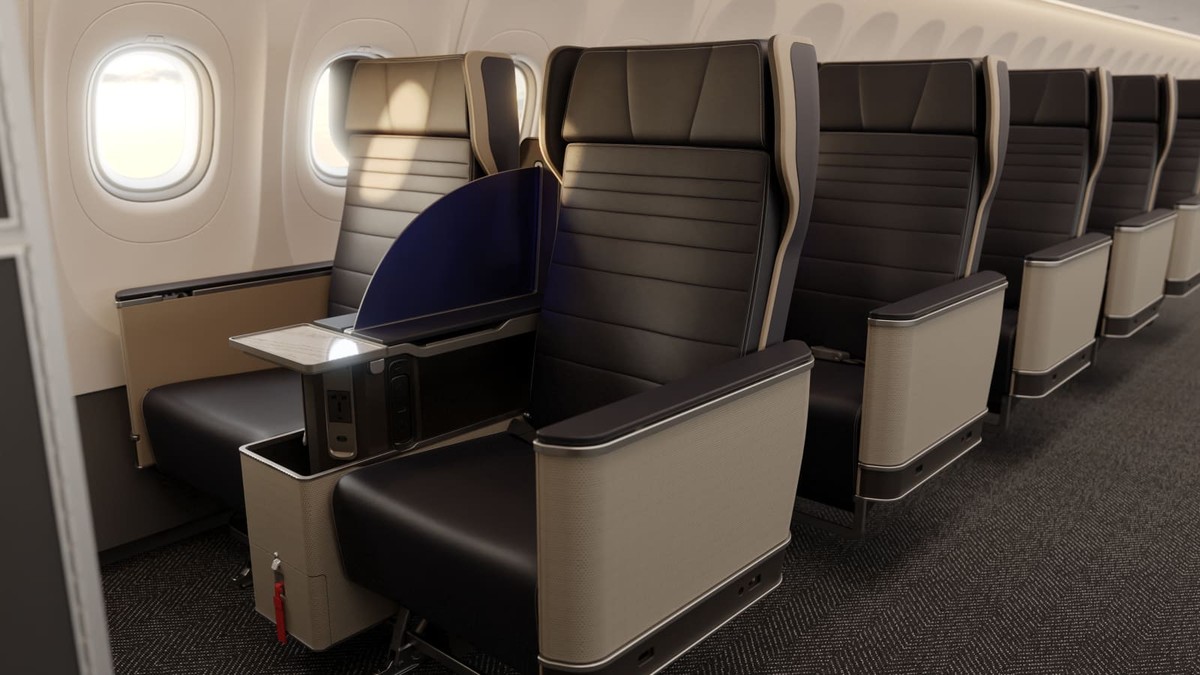
Quick answer: United First Base is a stripped down first class fare now live on domestic routes: the same first class seat, but paid seat selection, one checked bag, no flight changes, and nonrefundable. On a Christmas week San Francisco to Phoenix round trip, Base costs $839 per person versus $989 for Standard, saving $150 per person or $600 for a family of four.
Basic economy took over the back of the plane more than a decade ago. Now it has reached the front. United First Base is live on domestic routes, and I found it in an actual booking flow on October 28, 2026: a nonstop from San Francisco to Phoenix, United First Base, most restrictive, for $471. The seat is the same first class seat. Almost everything around it is stripped.
United announced the fare on September 30, with coverage from The Points Guy, USA Today, and the New York Post in the days after. The plan was a fall rollout of three fare tiers for United First and United Business. The announcement is a month old. What is new is that Base fares are now actually bookable on domestic routes. Here is what they take away, and when they are still worth it for a family.
What United First Base takes away
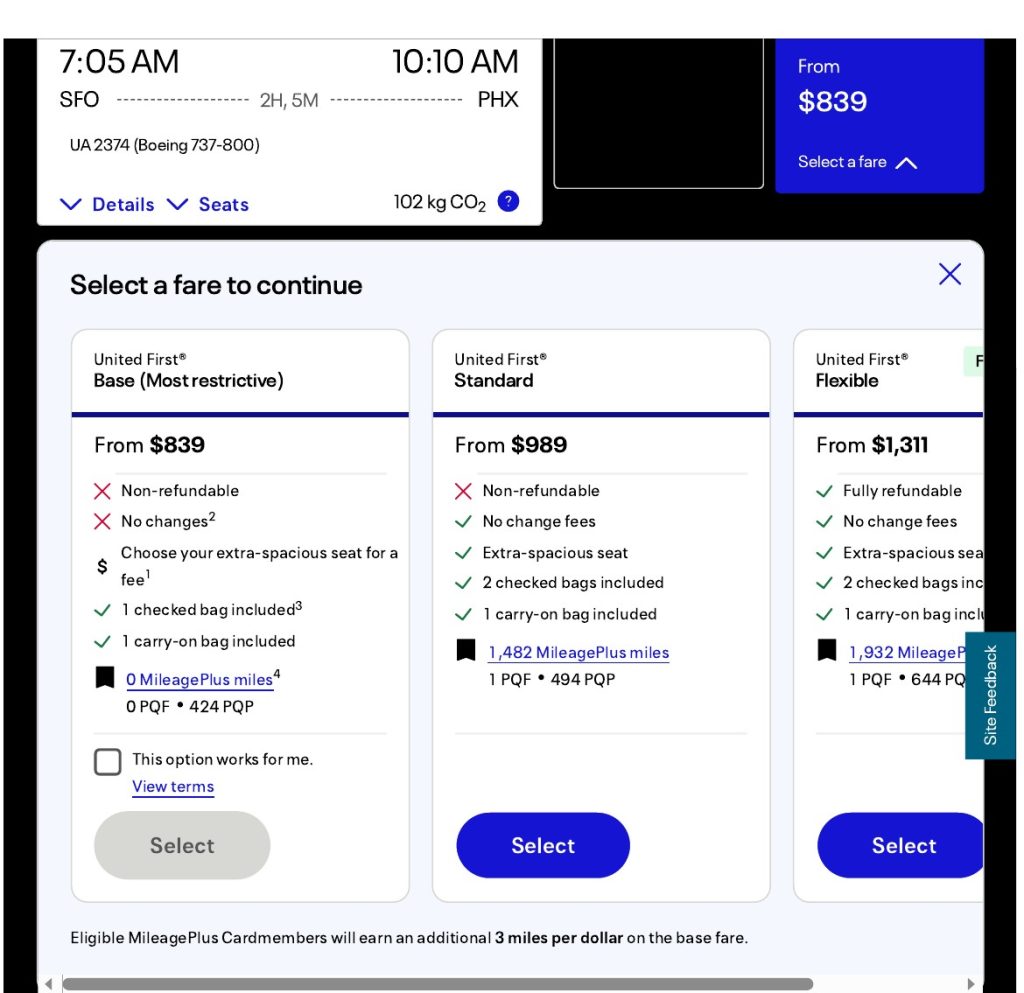
The three tiers for domestic United First break down like this.
Base is the cheapest tier. Seat selection costs a fee. You get one checked bag and one carry on. No flight changes. Nonrefundable. On the San Francisco to Phoenix fare I found, the display showed 0 MileagePlus miles and 0 PQF, though 424 PQP still posted.
Standard is the middle tier. Free seat selection, two checked bags, one carry on, and flight changes. Still nonrefundable.
Flexible is the top tier. Free seat selection, two checked bags, one carry on, flight changes, and refunds.
The short haul international version, United Business Base for Canada, Latin America, and the Caribbean, carries the same restrictions with one difference: United Club access stays included where the route normally grants it.
What does not change is the onboard experience. United says every tier includes the same elevated onboard experience in that cabin. You sit in the same seat, get the same service, and eat the same meal. Base only changes the ticket rules around the seat.
United.com
Why this matters more for families
For a solo traveler with fixed plans, Base can be a genuine deal: a cheaper way into the first class cabin. For a family, the math changes fast, because every restriction multiplies by headcount.
Take seat selection. If choosing seats costs a fee per person, a family of four pays it four times. If you skip it, you risk scattered seats, which is the one thing you do not want with kids. Take bags. Base includes one checked bag instead of two, so a family that packs heavy either pays for the second bag or packs tighter. Take changes. Family plans shift. A kid gets sick, a school event moves, a meeting runs long. On a Base fare, you cannot change the flight at all. That is the restriction I would weigh hardest.
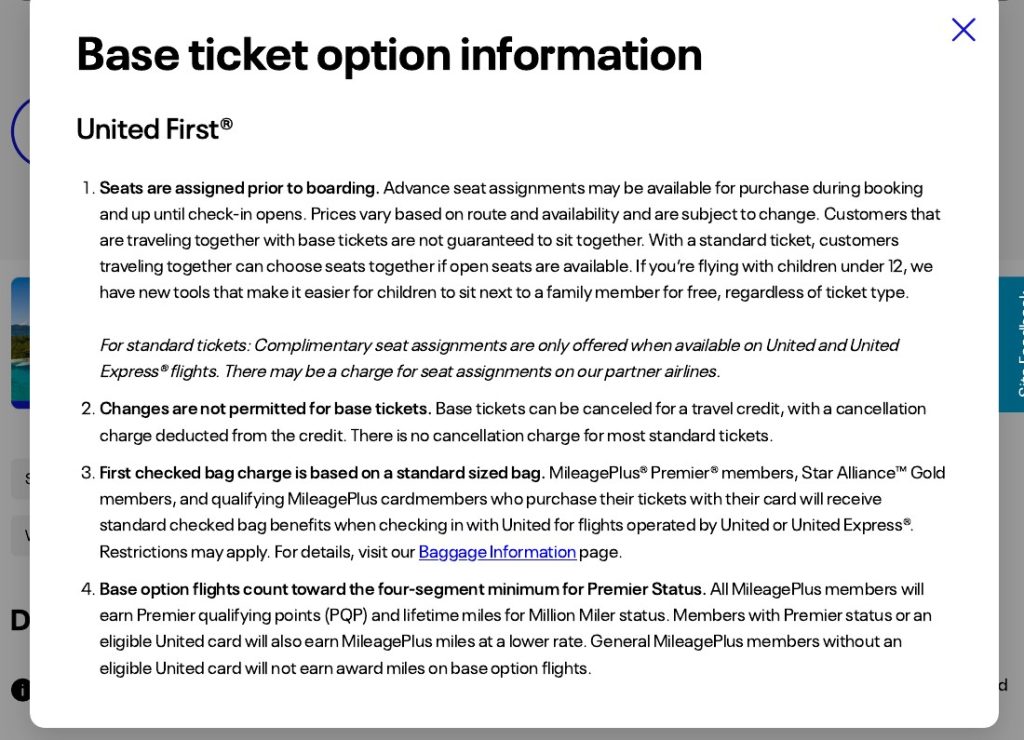
Then there is the earning side. On the fare I found, Base earned 0 miles and 0 PQF. Coverage of the announcement described reduced earning at the basic rate, but the display I saw showed zero outright. Your fare display may vary by route, so check the earning line before you buy. If you are chasing status, 0 PQF means the flight does nothing for the segment side of qualification, even though PQP still posts. For our family, miles are the currency that funds the next trip, so a first class fare that earns none needs a much bigger cash discount to make sense. United’s own Base ticket details confirm the split: Premier members and eligible cardmembers earn miles at a lower rate, while general members without an eligible card earn no award miles on Base flights.
United.com
To make it concrete, on a Christmas-week San Francisco to Phoenix roundtrip I priced (December 25 to 27, UA 2374), Base was $839 roundtrip per person, Standard $989, and Flexible $1,311. Base saves $150 per person against Standard, $600 for a family of four, but gives up free seat selection, a second bag, changes, and 1,482 MileagePlus miles per person.
Here is the break even test I use. Price Base plus seat fees for everyone plus any extra bag fees, then price Standard. If Base is still meaningfully cheaper and your plans are truly fixed, take Base. If the gap closes to a small amount once the fees are added, Standard is the better buy, because it adds free seat selection, a second bag, and changes. Never compare the headline Base price against Standard without adding the fees first. That comparison is how the stripped fare wins on paper and loses in practice.
Industry analyst Henry Harteveldt of Atmosphere Research Group called this kind of unbundling an indirect fare hike, because travelers often end up paying the old price for less. United frames it as choice, saying you can select the tier with benefits that fit your travel needs. Both things can be true. It is more choice, and the choice that used to be included now costs extra.
The wider pattern
United is not alone here, and this did not start with first class. United unbundled its long haul Polaris business class and Premium Plus premium economy cabins earlier in 2026. Delta and JetBlue have rolled out similarly stripped fares in their premium cabins in recent months. The direction across the industry is clear: every cabin gets a cheap, restrictive tier and a pricier, flexible tier, and the bundled middle keeps shrinking.
For points families, the practical rule is simple. When you see a first class fare that looks unusually cheap, check the fare tier before you celebrate. Base, most restrictive, is the label to watch for. If the trip is fixed, the seats do not matter, and you do not care about earning miles, it is a real way to fly up front for less. If any of those conditions fails, pay for Standard.
What is United First Base?
United First Base is the cheapest, most restrictive fare tier in United’s domestic first class cabin. It buys the same seat and onboard service as other first class fares, but with seat selection for a fee, one checked bag instead of two, no flight changes, and no refunds.
Is United First Base live now?
Yes. United announced it on September 30, 2026 for a fall rollout, and Base fares are now showing in domestic booking flows. I found one on October 28 on a San Francisco to Phoenix nonstop.
How many miles do you earn on United First Base?
On the fare I found, the display showed 0 MileagePlus miles and 0 PQF, with 424 PQP still posting. Announcement coverage described reduced earning at the basic rate. Check the earning line on your own fare display before buying, since it may vary by route.
Can you change or cancel a United First Base ticket?
No changes are allowed, and the fare is nonrefundable. Canceling gets a reduced flight credit after a fee, according to announcement coverage. If your plans might shift, Standard or Flexible is the safer buy.
Does United First Base include lounge access?
Domestic first class does not normally include United Club access, so there is nothing to strip there. On short haul international United Business Base routes, Club access stays included where the route normally grants it.
When is United First Base worth it for a family?
When plans are fixed, you do not need to choose seats in advance, one checked bag per person is enough, and you do not care about earning miles. Run the break even test first: add seat fees for everyone and any extra bag fees to the Base price, then compare against Standard. If the gap is small, Standard wins.
Leave a Reply